Friday, 8 November 2013

Sound


Sound

Definition of Sound:
Noun
The vibrations that travel through the air or another medium and can be heard when they reach a person's or animal's ear.

In class we were discussing sound and decided to start the lesson off by identifying 5 different very famous theme tunes of TV programs. There were two very important questions we had to answer these were:
ü  How does it make you feel?
ü  What type of program are you expecting it to be?


The Fresh Prince of Bel Air:


How does it make you feel?
- This sound makes me feel happy and just puts me in a good mood. It also tempts me to sing along to the rap.
 
What type of program are you expecting it to be?
- I personally think the music was aimed at kids because it is upbeat but also being there is a rap it might include teenagers. Another thing is the rap it states that he is from west Philly indicating it is an American TV show.

The A-Team:


How does it make you feel?      
- The sound makes me feel empowered and important in some way, but I personally feel as if I am on a mission whilst listening to this music.

What type of program are you expecting it to be?
- This music is mainly aimed at adults; I say this because it sounds as if it had aged comparing to the first one. When I first listened to it I instantly thought about super heroes that are on a mission of some sort. Also the sound/music varies between American and British.


Dr Who?


How does it make you feel?
- The sound is very dark and makes me wonder what is going to happen next. As if I am actually part-taking in the TV show. 

What type of program are you expecting it to be?
- This music is aimed at Sci-Fi fans because of the way the music has been synthesised. Being that I have said that I do believe with music like that there will be a lot of alien characters, maybe appealing to young boys.


Eastenders:


How does it make you feel?
- The sound is very happy at the beginning but I think as it gets to the middle of the music not only does it sound 'Christmassy' but as if it can be dark at the same time. 

What type of program are you expecting it to be?
- This music is very family friendly so I believe it is aimed at any ages group but I also think it can be very dramatic because of the dark sounds (bang bang).


Hollyoaks:


How does it make you feel?
- The sound is very upbeat and happy.

What type of program are you expecting it to be?
- The music also sounds family friendly but also like a documentary intro. What I mean by this is near the end of the theme tune it sounded like animals, making me think it would be an intro for a wildlife show.
 

After the task we then went on to discuss the technical aspects of sound and the key words.

Keywords:

Soundtrack - The narrow strip at one side of a movie film that carries the sound recording.

Theme Music - A melody used to introduce or identify a television or radio programme, a dance band, a performer.

Sound Effects - A sound other than speech or music made artificially for use in a play, film, or other broadcast production.

Ambient Sound - The background sounds which are presented in a scene or location.

Dialogue - A conversation between two or more people as a feature of a book, play, or film.

Voice Over - A piece of narration in a film or broadcast, not accompanied by an image of the speaker.                                                                                    

Direct Address - The use of a term or name for the person spoken to, as in securing the attention of the person.

Diegetic Sound (natural) – The sound of which is visible on the screen or what is implied to be presented by the action of the film these are:

ü  Voices of characters

ü  Sounds made by objects in the story

ü  Music represented as coming from instruments in the story space

Non - Diegetic Sound (man-made) – The sound of which is neither visible on the screen nor has been implied to be present in the action these are:

ü  Narrator's commentary

ü  Sound effects which is added for the dramatic effect

ü  Mood music

Sound Bridge - When the scene begins with the reminder sound from the previous scene before the new sound begins.

Parallel Sound - The sound you hear that would naturally go hand in hand with the film on screen.

Contrapuntal Sound – The sound you hear that you wouldn’t associate with the events on screen.

We then colour coordinated the list with Blue Diegetic sounds and Red as Non – Diegetic sounds. As you see in the list ‘Direct Address’ is coloured with both red and blue this means that it can be both.

Why is sound used in television programs?
From my point of view I think sound is used in television programs because without sound we would not know what the characters are saying and they wouldn't know what mood they are meant to set. Causing upset throughout the audience.

Film Production


Film Process


Before we were given our preliminary task were separated into groups and told to discuss how we thought the film production works. The Image below is what we as a group came up with.

 
We divided the list into 3 three parts:

ü  Pre - Production
ü  Productions
ü  Post - Productions


Pre - Productions - Pre-Productions is what is done before the actual filming has started. This would consist of hiring cast members, designing costumes, building stages, preparing script, deciding the location, creating a story board and many more 

Productions - Productions is when the filming has started. In productions all the stuff that were completed in pre productions now contributes to the final outcome.

Post Productions - Now Post Productions is the last stage in film production, this is when the trailer has been developed and is 'leaked' so the public have time to comment on and their comments are then to be reviewed by the film staff. This is also the time when they get to set dates for the releases and meet the general public.

Monday, 4 November 2013

Angles


Angles


In class we broke down the different meanings for angles, this applied to our practical work greatly as it helped us to improve previous work that needed to redo
For example in my group’s preliminary task we used so many different complicated shots that it just made our clip very confusing. We then learned about these different angles and redid the preliminary task using several of the angles and movements that are listed

Camera Angle
Noun
The mathematic angle/degree at which the camera is set up at, usually classified into low, mid and high angle.

Static Shot
Noun
A shot that lacks any form of movement: Tilt, Pan, Zoom and Track.
- The shots that are listed below are frequently used in the film industry. 
 
Pan
Noun
When the camera moves side to side on a fixed point.

Panning 
 
Tilt
Noun
When the camera moves up and down from a fixed point.
Tilt

Zoom
Noun
When the camera lens moves in and out from a fixed point.
Zoom


Track
Noun
When the camera follows a subject and is unattached from a fixed point.


Tracking an object (Behind the scenes)


Shot Types


Shot Types

Definition
Shot types are the shots used in a scene that can have an intense effect audience and enhance their reaction. Shot types are generally decided upon in pre-production and are firstly story boarded so that everyone involved knows what they need to do when it comes to filming.
 
EWS (Extra Wide Shot)
·         A shot of the landscape, this normally used to display a character and their surroundings (setting and mise en scene).
·         On a camera this would be 100% zoomed out.


VWS (Very Wide Shot)
·         A shot that also shows the landscape and the character.
·         On a camera would be 90% zoomed out.


WS/LS/FS (Wide Shot/Long Shot/Full Shot)
·         Shows just the whole character and the settings.
·         On a camera 50% zoomed out.

 
MS (Mid-Shot)
·         Shows some part of the character in more detail while still showing surroundings.
·         On a camera 40% zoomed out.
 
MCU (Medium/Mid Close up)
·         This shot is in between mid – shot and close up, this would display the head and the neck.
·         On a camera 30% zoomed out.
 
CU (Close Up)
·         A feature that takes up the whole frame.
·         On a camera 20% zoomed out.
 
ECU (Extreme Close Up)
·         Shows a certain feature in very sharp detail.
·         On a camera 10% zoomed out.
 
CI (Cut In)
·         Focuses on another body part in detail.
·         On a camera also 10% zoomed out.


CA (Cut Away)
·         A shot of something other than setting or character.
 
2 Shot
·         A shot that includes two people.
 
OSS (Over shoulder Shot)
·         A shot that is looking over a person’s shoulder looking onto someone else.
 
Noddy Shot
·         This shot is mainly to do with sound.
·         It is from an ‘Interviewers Perspective’ so this means you can hear them but you cannot see them.
 
POV (Point of View Shot)
·         Show the view from the person’s perspective.

 
WS (Weather Shot)
·         This is a shot that only displays the weather, mainly for the background.


Reflection
These different shot types are used in all the mini clips we have created, when creating a movie yes you plan ahead about what shots you want to use but when it comes to filming, these shots change and you end up using a range of different shots. This can be a positive and negative aspect as yes you have a lot of shots that help tell the story but it can also make your movie or clip look cheap and lower the quality.

Monday, 21 October 2013

Preliminary Task


Preliminary Task


We were given a preliminary task with the brief that said 'A character opens a door, crosses a room and sits down in a chair opposite another character, with whom she/he then exchanged a couple of lines of dialogue'.


In groups we discussed the brief and came up with idea of having an interview between a police officer and a young girl that killed someone. To add to the plot the young girl was suffering from noises in her head, therefore this lead her to killing. With this idea we then started to draw up a story board that is shown below.


Story Board
Once the idea had been pitched and the story board had be completed we then started casting roles. After we casted roles it was time to move on to the next stage this was writing the script and creating the shot list. The passage below is a copy of the script that was used:

Script

Scene 1

(Door slams Lauren walks in)

Sophie - Who's there? (Feeling anxious and paranoid)

(No answer)

Lauren - (goes to shake hand) Hello my name is Inspector Amber Watkins, please take a seat.

Sophie - (ignores friendly gesture and looks away) no speech

(Lauren sits down and waits for Sophie to respond to orders) (Not bothered facial expression)

... Pause of silence

(Lauren sorts out papers and puts recording on table)

(Sophie continues to fidget and breathing heavily)

Sophie - I did nothing wrong, they did it.

(Lauren looking emotion less)

(Lauren starts recording)

Lauren - At 16:37 Nicole parsons was found dead in the back garden of Madison bloom, what is your take on this?

Sophie - (mumbling to herself) I didn't do it, i did nothing wrong.

Lauren - where were between hours of 4 and 5 o clock Saturday evening?

Sophie - I was with them

Lauren - (looking angry and concerned) who is ... them?

Sophie - (walks into spotlight) Their my friends ... erm ... (hesitates) My friends ... (screams) Don't you believe me? (Slams hands on table)

Lauren - Calm down (reaches for Sophie’s hand)

(Sophie moves hands, and walks backwards)

Scene 2

(Sapir grabs Sophie’s shoulders)

Sapir - Hello there (sly face)

Desiree - so how yah been Madi?  Killed anyone lately?  (Grins repeatedly) (Sly face)

Sapir - Yea Madi, Killed anyone lately? (Touching her hair)

Sophie - (faces windows) I didn't kill anyone ... You did it ... Why don't you guys just own up? (Controlling voice)

Desiree - So what if we killed her? No one will find out! (Flicks Sophie’s hair) (walking around her)

Sapir - Technically (emphasis on the 'Y') you killed her, because you hand the knife. We didn’t tell you what to do.

(Sophie should be silent, but looking angry)

Desiree - whooooa is someone getting angry? (Laughs and pokes her)

Sapir - Is someone going to throw a tantrum? (Laughs and pokes her)

(Sapir and Desiree push Sophie around)

Sophie - (screams) stop it, stop it ... I didn’t do anything, it wasn’t my fault ...

Scene 3

(Lauren scared and very worried)

(Lauren looks at Sophie whilst she is getting knocked about)

Lauren - Who are you talking to?

Sophie - (Realised she is alone) I was talking to my friends.

Lauren - Where are your friends?

Sophie - They are right here.

(Sapir and Desiree make a mess)

(Sophie wide eyed and scared)

Lauren - Stay here I'll be back

(Lauren sprints away)

(Sapir appears and drags Sophie head to the table)

(Sophie bends down)

Sapir - This is for your own good

(Sapir’s passes Desiree the hair) (Desiree wraps round hand)

Desiree - This is what’s best for you...
(Slams head on table)
(Sophie collapses on floor)


As it was an interview we decided to set our movie in the drama studio. Reasons for the drama studio are its very spacious giving us the right amount of room to set up in and preform in. It also contains its own personal lighting board; this made everything 10 times better as unlike natural light we could control the colour and the brightness.


Embedded image permalink
Drama Studio: Location of Filming
Once we had filmed all the shots we needed we then went on to edit the raw footage using ‘Final Cut Pro (FCP)’ on the apple macs. At first our director edited the whole movie and then presented it to us, we were then given some extra information from our teacher when applying it our movie at the time it did meet the demands. Lauren and I both took it upon ourselves to re-edit the footage that was given up. After days of editing we had finally completed the task and meant the requirements.


Old Movie 

Unfortunately, as a group we decided that the first movie was very complicated and we redid everything. Once we had completed our new movie it was much more understandable and easier follow.

 New Movie 


As the new director I got all the shots that were needed and many more. The aim for this second piece was to keep it simple and very natural, being so we then decided to have a topic and have the characters elaborate on the topic given. Some people may think this would have never worked but our cast members were very good at remembering everything they said for extra shots. The editing this time round was done by Lauren who did a great job bringing every thing together.

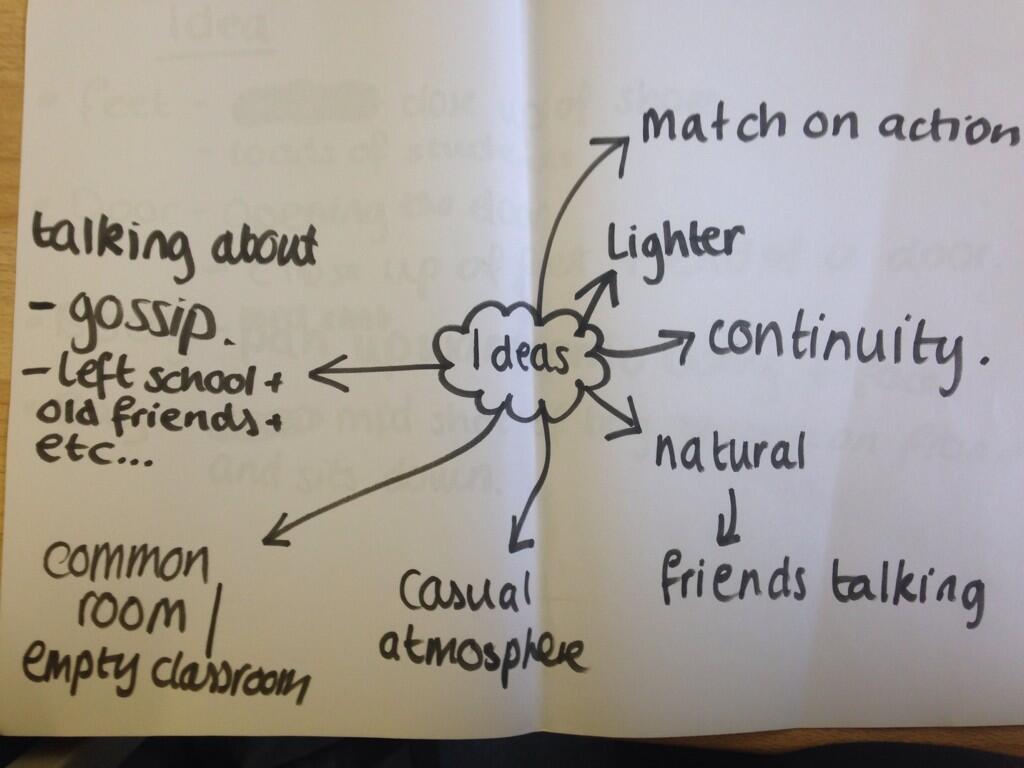
Mind - Map of Ideas

Embedded image permalink
The group discussing ideas
Our new shot list
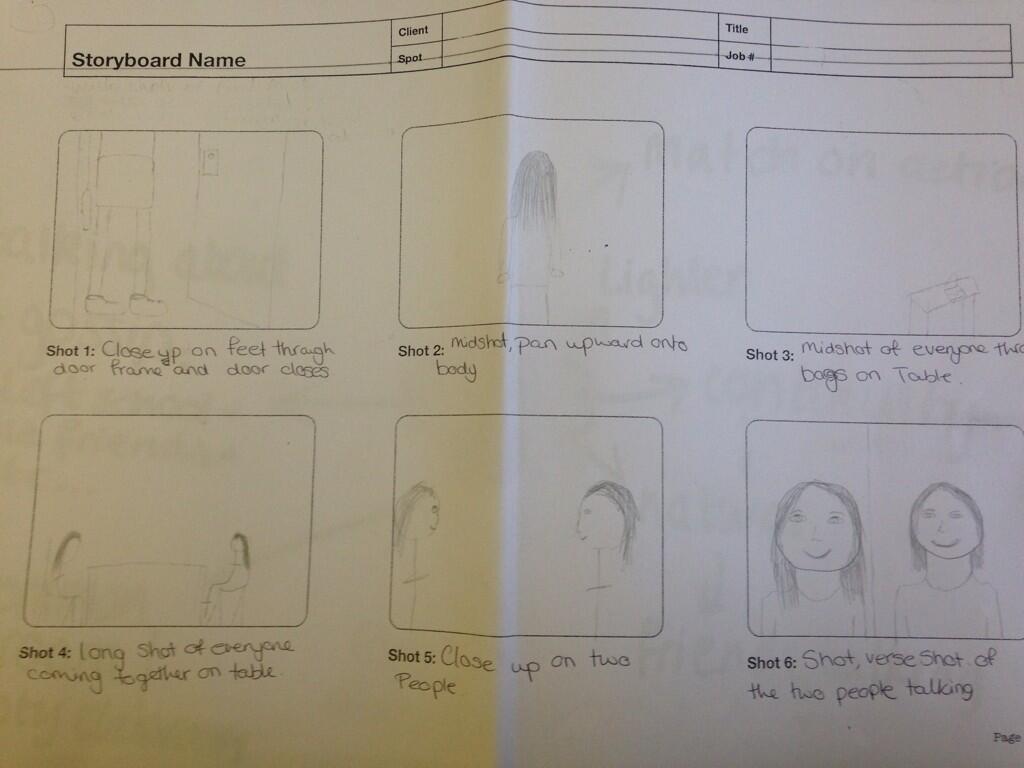
Our new story board
Filming in Process

Match on Action


Match on Action

Definition:
Match on action is a very simple but essential technique, where the perspective of the camera changes during a scene and the scene continues to flow.

As a class we came up with the definition of match on action below after we did a practical that included 2 people throwing and catching a ball. In the practical we had to have at least 4 different types of shots from different angles and then cut them together using the iMovie on the iPads.
 
Class Definition:
Match on Action is the sequencing of events in chronological order to maintain continuity so the narrative can be followed. This is done by matching the footer of one scene to the header of the next.
We then watched them back as a class and discovered all the match on action mistakes each group made.
As a class we then made a list/spider diagram of rules that should be followed when creating a film to ensure there are no match on action mistakes.